-The replacement of traditional way on making the food-
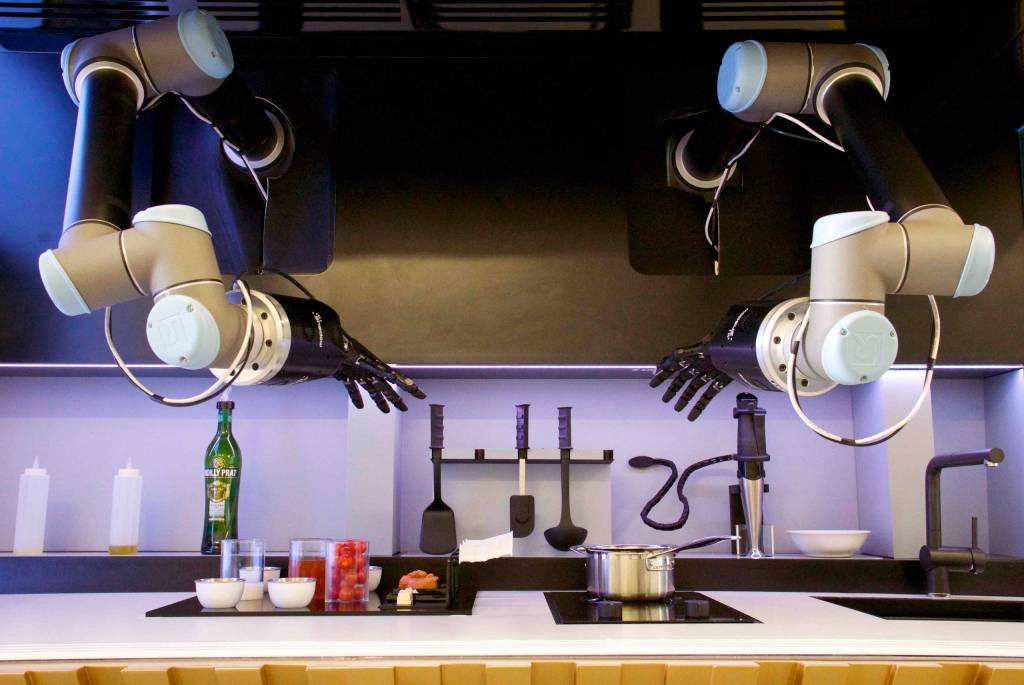
Before this blog kick off the statement, a few questions are raised for readers. Are you willing to eat the food which is made by robots or the food is made by manual chefs? Will chefs or cooks be replaced by AI in the future?
Nowadays, working with AI in a restaurant is no longer a dream and it has successfully penetrated into the market. The involvement of robots is beneficial regarding food preparation, detect food safety issues, food production, and help with developing new flavours and recipes.(Matthews, 2019) This brings about a term “Robotic kitchen”, and the concept of that is briefly about 3 steps. Ordering the food on smart devices like iPad, then pay electrically and the order information will be transferred to AI, finally robots will prepare and deliver the food to customers.
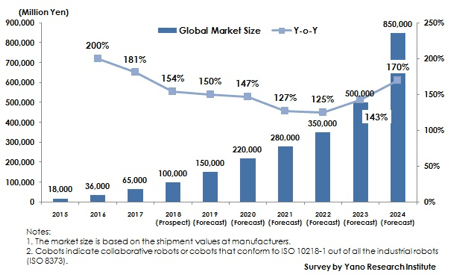
Basically, it is feasible to apply “cobot” as AI assistant in terms of proceeding simple culinary tasks automatically, such as deliver food ingredients, and cooking patties or even keep consistency of flavour. Infosys claimed that “businesses begin using AI to automate and routine or inefficient processes”. (Futurelearn, 2020) So that, it becomes more efficient and accurate than cooks for the sake of eliminating expenditures on salaries and using time effectively. Moreover, the robot is also much more accurate or we can say “ease the burden of chefs” in relation to providing personalised meals. What can manual chefs do is focusing on valuable and delicate tasks which is supported by Noel Sharkey’s statement, at least for now this role is in charge of by manual chefs. For instance, a secret recipe, or food innovation. No matter what, the global market size of the cobot is expected to reach to 850,000 million Japanese yen in 2024, and it has been continuously growing since 2015. (Yano research institute ltd, 2018)
With all of these benefits by using robotics, the traditional way has combined with digitalization based on machine learning algorithm. A good example is “Miso Robotics” whose robots are taking the role of the grill and fryer.
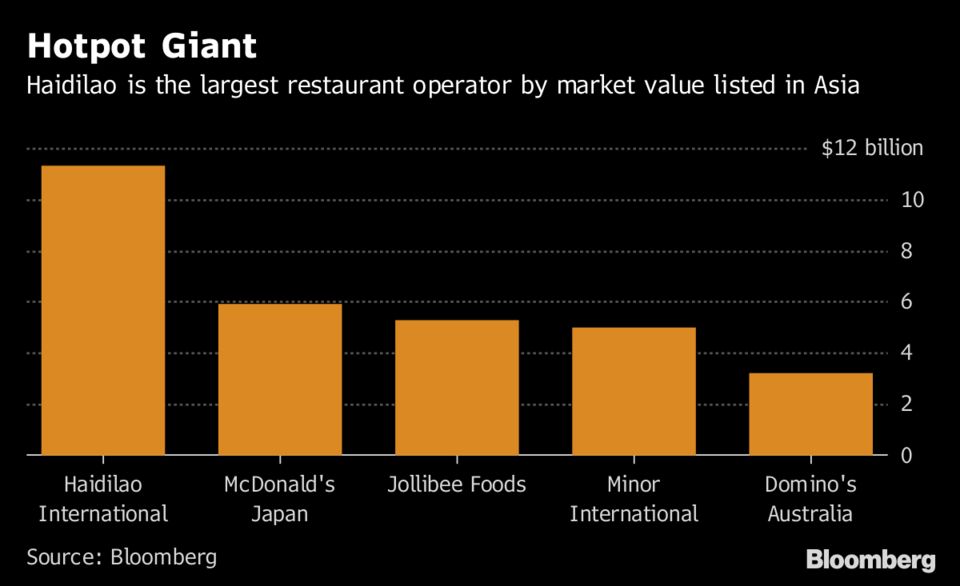
There are many of successful companies running their business with robots, such as Spyce and Haidilao Hot Pot. The AI (robots) even can In 2018, Haidilao had gained tremendous amount of profits with 19.97 billion Chinese yuan. (Statista, 2020) The question is that how did they manage to operate businesses with robots successfully? Especially for a company like Haidilao Hot Pot, it has been identified as the largest restaurant operator by market value listed in Asia. (Bloomberg, 2018) Some of the reasons for that could be a huge population size in China, brilliant customer services and its own expansion plan. There is assumption that could be a meaningful reason as some of customers are more enjoyable on watching robotic processes instead of the food itself. In my experience, the flavour at Hadilao restaurant is quit same as other hotpot restaurants.
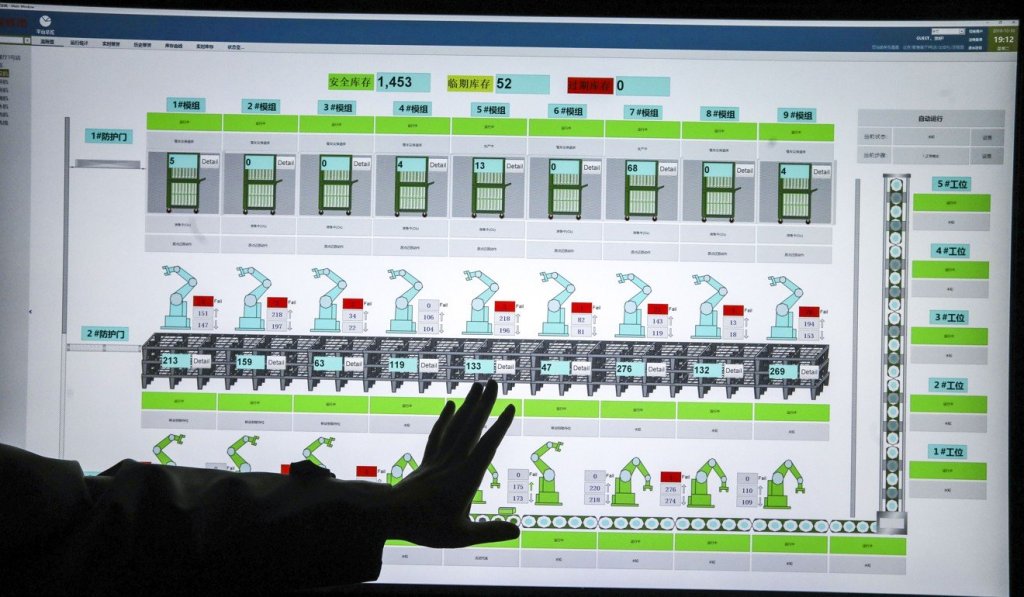
It seems to be a challenge in which customers needs more time to get used to it and some of customers are more sensible of flavour and have established emotional engagement with manual cooks. It is an obvious phenomenon that more young customers are not resistant on eating at a robotic restaurant and literally have more adaption and familiarity of engaging with AI. Hence, it has become a new trend of eating food. Despite that, some of old customers are much more acceptable on the food which was made by manual chefs due to their subjective ideology is more important than objective one.
Although there is a gap between emotional customers and AI, the tendency of the change to robotics or automation will steadily push forward and eventually lead to a semi-automatisation or full-automation. In optimistic view, the robotic restaurant is convenient and efficient to serve the food to customers on fast food industry, but in pessimistic view, it may cause chefs or cooks losing jobs. According to the website called “Will robots take my job”, the percentage of voting cooks and restaurant will be replaced by AI and robots is 96%, surprisingly it grows up to 14% by 2024. (Will robots take my job, 2020) To my understanding, there will be a contradiction if an important recipe being taken by AI which means it actually harms the self-esteem and self-achievement of manual chefs. In other words, the AI steal their knowledge because AI (Robots) is learning fast. Likewise, human interaction with emotions is in favour of consolidating status of chefs in digital economy. This is because the current AI technology is lack of emotions.
Thereby, the role of chefs will be changed by AI but cannot be replaced as making food is the nature of human-being. best consequence is to insist on semi-automatisation for those who wants to be chefs within next few decades, but nobody knows the truth of the future.
Consequently, there is an interesting tool which is called “Gastrograph’s guiding principle“. It tells us that everyone experiences flavour a little differently. Therefore, if this feature is attached to AI technolgoy, then it would ruminate limitless sensory possibilities on a flavour, but somehow human-being could fail to notice. (Berenstein, 2018) If that is the case, the role of manual chefs will highly likely be replaced by AI (robots) in the future as AI is much more intelligent than human. This will be able to pose a situation in a dilemma from perspective of human rights.
References:
Winterstone pictures (2018, Feb 22). Flippy “making chefs more creative” |Miso Robotics [Video file]. Retrieved from https://www.youtube.com/watch?v=LTfIwsH1xIs
South China Morning Post (2018, Nov 6). Inside China’s first AI hotpot restaurant [Video file]. Retrieved from https://www.youtube.com/watch?v=sj7B0Y___c4
Spycefoodco (2018, May 3). Spyce-Robotic restaurant by four MIT graduates in collaboration with chef Daniel Boulud [Video file]. Retrieved from https://www.youtube.com/watch?time_continue=11&v=9LqqcDL99UA&feature=emb_title
Yano research institute Ltd. (2018) global cobot market size in 2017 Attained 65,000 million yen. Retrieved from https://www.yanoresearch.com/en/press-release/show/press_id/2044
Du, L, Maki, A. (2018) Robots are serving spicy soup at Haidilao’s hotpot restaurants. Retrieved from: https://www.bloombergquint.com/pursuits/robots-serving-spicy-soup-is-key-to-hotpot-chain-s-expansion
Tao, L. (2018) A first-hand review of Haidilao’s ‘smart’ hotpot restaurant in Beijing. Retrieved from https://www.scmp.com/tech/article/2171402/first-hand-review-haidilaos-smart-hotpot-restaurant-beijing
Naylor, T. (2019) Restaurants are now employing robots-should chefs be worried? Retrieved from https://www.theguardian.com/food/2019/mar/07/food-tech-the-march-of-the-robots-reaches-the-kitchen
Matthews, K. (2019) Restaurants and robots: how AI might automate your dining. Retrieved from https://datacenterfrontier.com/restaurants-test-drive-ai-and-robotics-to-automate-your-dining/
Berenstein, N. (2018) Tastemakers: can a robot really know what we’ll want to eat? Retrieved from: https://www.theguardian.com/lifeandstyle/2018/may/23/food-for-thought-will-an-era-of-hyper-personalized-meals-leave-a-sour-taste
Scherer, M, Robinson, J; Adler, D (2018) What risks restaurants should consider before deploying AI, robotics and automation. Retrieved from https://www.restaurantdive.com/news/what-risks-restaurants-should-consider-before-deploying-ai-robotics-and-au/539840/
Miso Robotics (2020) Cloud-connected learning platform. Retrieved from https://misorobotics.com/miso-ai/
Statista (2020) Revenue of Chinese restaurant chain Haidilao group from 2015 to 2018. Retrieved from https://www.statista.com/statistics/999071/china-revenue-of-haidilao-group/
Will robots take my job? (2020) Cooks, Restaurant. Retrieved from https://willrobotstakemyjob.com/35-2014-cooks-restaurant
Moley Robotics. (2015) Meet the robot chef that can prepare your dinner. Retrieved from: https://time.com/3819525/robot-chef-moley-robotics/
Futurelearn (2020) Artificial Intelligence (AI) Retrieved from https://www.futurelearn.com/courses/creating-your-future/4/steps/652900
 Ysir
Ysir 
Hi,
This is an interesting post. I am glad to hear you mention AI in kitchen, which I have seen several successful examples before, such as a noodle-shaving robot that helps saving time as well as energy to shave the high-quality noodles.
When it comes to service, there is a tendency of automatic as well. More specifically, the role of waiter is being replaced by machines that people can make orders through and that can even deliver the food directly to the customer.
Taking Alibaba’s “Robot. He” diners as an example, which is a table-high machine that roll around the dining room in China. “But we don’t need two shifts for robots and they are on duty every day.” Mentioned Cao Haitao, the Alibaba product manager who developed the concept. It is true that it will save a lot of money as robots never get tired.
LikeLike
Hi, Coconia. Much appreciated for your comments! I was glad that you find it interesting! Indeed, it has the same concept as Alibaba’s “Robot.He” and a lot of tasks are managed by AI (Robots) in the dining room. I have visited to ‘Robotic Restaurant” in several times and the food was scrumptious. The fact is that I really cannot tell the difference between manually-cooked food and robot-cooked food. By the way, I think this is a good business cause it still seems new and can be a selling point for young customers.
LikeLike
Hello,Ysir! The content of this blog is really attractive! My question for this blog is whether the application of AI can indeed decrease the operating cost of restaurants? For big companies like Haidilao, almost all the servicing process are operated by robot. But we can find that some works in the servicing process still need human waiters or chefs to completed. Therefore, those intelligent restaurants need to pay both two parts of operating cost-human cost and equipment cost. Furthermore, initial investment on AI automation is really high because of the limitation of technology. In addition the investment on AI also includes repairment and continuous algorithm optimization. Therefore, in my opinion, such expensive cost is the block of popularizing application of AI technology in small and medium restaurant.(May not including fast chain restaurant).And for big restaurants, whether the cost of human-robot coordinating operating mode is really lower than the cost of tradition operating mode?
LikeLike
Hi, Tony. Thanks a lot for your comments and compliments! Yeah, costs on AI technologies could be high, but it really does not matter for big companies like Haidilao or MacDonald cause they have strong customer loyalty and reputation. So, they have enough money to afford costs on both AI technologies and remaining workers. I think the AI technologies will become more advanced and affordable for restaurant businesses in the future once it is becoming more common in many different fields of businesses. So, it is not the right occasion to invest on AI technologies for small-medium size restaurants at current stage.However, we have to admit that the application of AI is more efficient than human beings on dealing with simply tasks and serving huge amount of customers at the same time. For instance, if you are running a restaurant in New York, Shanghai, or London, the density of customers is high, so it would be appropriate to use AI in order to catch up the pace of demands. As you said, there are still lots of limitations of using AI technologies, but I strongly believe that the application of AI will be more common for restaurants business. In other words, the main trend of using AI will force you to change in competitive markets.
LikeLike